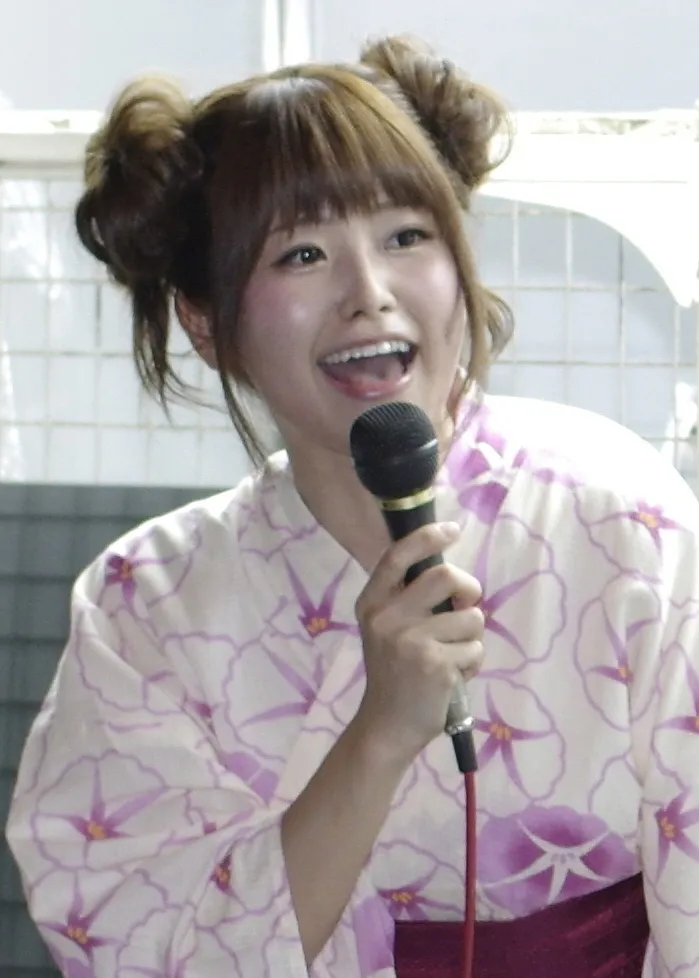
Stretching Every Limit: The Roles That Prove Tsugumi Kataoka Is One of the Most Versatile Performers Working Today
Photo: SMU Central University Libraries, No restrictions, via Wikimedia Commons
Here's a fun little test: try to describe Tsugumi Kataoka's "type" as an actress. Go ahead. It's harder than it sounds.
She's played characters who are soft-spoken and internally shattered. She's played women who are fierce, manipulative, and morally complicated. She's navigated romantic comedies with genuine lightness and then turned around and delivered performances so emotionally devastating they leave audiences genuinely unsettled. Every time you think you've got a handle on what she does best, she goes and does something completely different — and somehow does that brilliantly too.
This is a deep dive into the roles that have defined her career, challenged her most, and revealed just how far her range actually extends.
The Art of Disappearing Into a Character
The best performers don't just play characters — they become them in a way that makes the performance feel less like acting and more like a window into a real person's inner life. Kataoka has demonstrated this quality repeatedly throughout her career, and it's arguably the thing that distinguishes her from peers who are technically skilled but somehow less magnetic.
What's striking about her approach is how physical it is. The way she carries herself changes noticeably from role to role — posture, eye contact, the rhythm of her speech. These aren't superficial choices. They suggest an actor who builds characters from the inside out, figuring out the psychology first and letting the physicality follow naturally from there.
Fans who've followed her career across multiple projects often comment on this. Watching a Kataoka performance back-to-back with another Kataoka performance can feel almost like watching two different people. That's a rare quality, and it doesn't happen by accident.
When Drama Gets Heavy: Her Most Emotionally Demanding Work
Among the performances that have drawn the most attention from both critics and fans are her turns in deeply dramatic material — stories that require sustained emotional intensity over the course of an entire series rather than just a single cathartic scene.
What makes these performances remarkable isn't just that she can access genuine emotion on screen. Lots of actors can cry on command. What Kataoka does is more sophisticated: she maps the arc of a character's emotional state across episodes, making sure that the grief or trauma or longing feels like it's building organically rather than being switched on and off depending on what a particular scene requires.
There's a control in her dramatic work that actually makes it hit harder. She never oversells a moment. The restraint is the point — audiences lean in because they can sense that something enormous is being held just beneath the surface, and the anticipation of that release is almost unbearable.
For fans accustomed to more expressive Western acting styles, this approach can take a minute to calibrate to. But once it clicks, it's genuinely hard to watch anyone else.
Playing Against Type: The Roles That Surprised Everyone
One of the most exciting things about Kataoka's career has been her willingness to accept roles that nobody saw coming. There's a particular kind of creative courage involved in taking on a character that runs completely counter to your established image, and she's done it more than once.
Her ventures into morally ambiguous territory — characters who are neither straightforwardly sympathetic nor purely villainous — have been especially revelatory. These are the hardest kinds of roles to pull off because they require the audience to hold contradictory feelings simultaneously: you understand why this person does what they do, even when what they do is not okay. Getting viewers to that complicated emotional place requires extraordinary precision from the performer.
Kataoka navigates that terrain with a confidence that suggests she genuinely enjoys the challenge. There's no sense that she's trying to make these characters likable in a conventional way. She's more interested in making them comprehensible — and that's a much more interesting artistic goal.
The Preparation Behind the Performance
Getting a glimpse into how Kataoka prepares for her roles is one of the things fans find most fascinating about following her career. While she's characteristically modest about her process in interviews, certain patterns emerge across multiple conversations and behind-the-scenes accounts.
Research is clearly a huge part of how she works. For roles that involve specific professional or cultural contexts she hasn't personally experienced, she goes deep — consulting with experts, spending time in relevant environments, building a foundation of authentic knowledge that informs even the smallest details of her performance.
There's also a strong sense that she thinks hard about the relationships in a script rather than just her own character in isolation. How her character sees other people, what she wants from them, what she fears they see in her — these dynamics appear to be central to how she constructs a performance from the ground up.
The result is that even her supporting characters in ensemble pieces feel fully realized. She doesn't phone anything in, regardless of how much or how little screen time a role involves.
Growth as a Through-Line
Looking at Kataoka's body of work as a whole, one of the most compelling narratives is her own evolution as a performer. The actress she is now — assured, adventurous, technically sophisticated — is clearly the product of deliberate artistic growth rather than just accumulated experience.
Early in her career, her strengths were already visible, but there's a particular kind of fearlessness that's developed over time. She takes bigger swings now. She trusts herself to sit in uncomfortable moments without rushing to resolve them. She's gotten better at doing less in ways that ultimately communicate more.
For fans who've been watching since the beginning, tracking that evolution is its own kind of pleasure. And for newer fans who are just discovering her work through streaming platforms, there's an entire back catalog waiting — a map of an artist figuring out, step by step, just how good she can be.
Spoiler: the answer is very, very good.