Why Tsugumi Kataoka's Quietest Moments Are Secretly Her Loudest
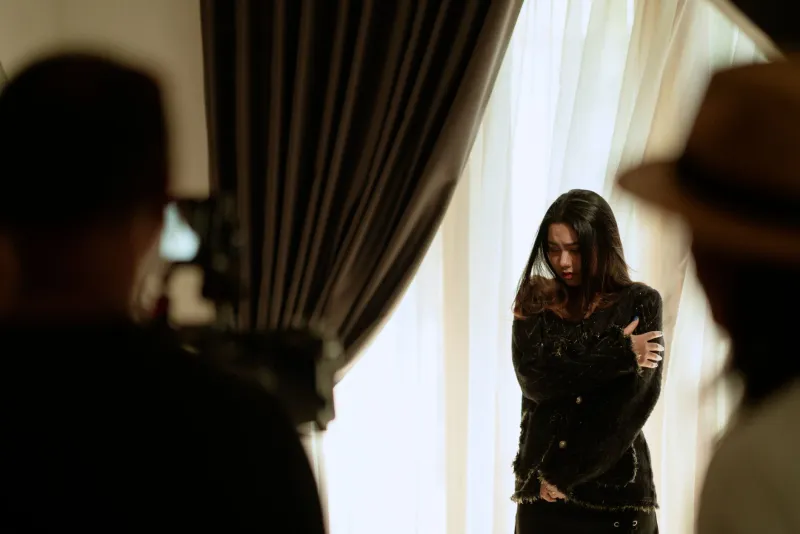
There's a scene — you probably know the one — where Tsugumi Kataoka sits across a table from another character, says maybe four words, and somehow manages to communicate an entire emotional history without moving much more than her eyes. If you've watched it, you felt it. If you haven't, well, buckle up, because that's exactly what we're here to talk about.
In an era where prestige TV and streaming dramas still reward the Big Speech, the tearful confession, the dramatic monologue delivered in close-up with a swelling score underneath — Kataoka is doing something genuinely different. And audiences, particularly American ones who weren't raised on Japanese performance traditions, are responding in ways that are measurable, documented, and honestly kind of fascinating.
The Brain on Restraint
Here's the thing about big, expressive performances: they do the work for you. When an actor cries, your brain registers grief. When they shout, you register anger. The emotional signal is loud and clear, and your nervous system responds accordingly. That's not a criticism — it's just how it works.
But what happens when the signal is quieter? When the actor holds back, when the expression is controlled, when the body language is minimal?
According to researchers studying narrative engagement and what's sometimes called "parasocial processing," audiences actually lean in harder when they have to interpret rather than simply receive. Film scholar Dr. Linda Choi, who studies cross-cultural spectatorship at USC, puts it this way: "When a performer gives you everything, you're a passenger. When they give you just enough, you become a co-author of the emotional experience. That's cognitively and emotionally stickier."
In other words, Kataoka's restraint isn't withholding. It's an invitation.
What the Numbers Are Saying
Streaming platforms have gotten very good at tracking what they call "engagement depth" — not just whether someone watched, but how they watched. Did they pause? Rewind? Screenshot? Clip and share?
The data around Kataoka's most minimal scenes tells a story. Episodes featuring her quieter, dialogue-sparse sequences consistently show higher rewind rates than her more verbally active scenes. Viewers are going back. They're watching the same thirty seconds again and again, trying to catch what they might have missed — a micro-expression, a breath, a barely-there shift in posture.
On social media, the clips that spread aren't the monologues. They're the silences. Fan accounts across TikTok, Twitter/X, and Tumblr have built entire threads around single reaction shots of Kataoka that last less than five seconds. "She said NOTHING and I cried for ten minutes" is basically a genre of fan post at this point.
Where This Comes From
It's worth understanding that Kataoka's approach didn't emerge in a vacuum. Japanese performance traditions — particularly in theatrical forms like Noh, but also in the more grounded realism of contemporary Japanese TV drama — have long valued ma, the meaningful pause, the space between actions. Silence isn't absence; it's presence of a different kind.
Western acting schools, particularly those rooted in the Stanislavski tradition and its American descendants (think: the Method, Meisner technique), have historically emphasized emotional availability and expressive truth. "Live truthfully under imaginary circumstances" sounds like it might produce the same results, but in practice, American training often rewards demonstrable emotion — emotion you can see.
Kataoka trained within Japanese systems but has clearly developed a hybrid approach that draws on both traditions. The emotional truth is there — you feel it — but the expression is filtered through a discipline that trusts the audience to meet her halfway.
Hollywood's "Bigger Is Better" Problem
Let's be honest about something: American prestige drama has a monologue addiction. Awards season is practically structured around them. The clip that gets submitted for Emmy consideration is usually the one where someone yells or weeps or delivers a four-minute speech about their dead father.
That's not wrong, exactly. Those scenes can be extraordinary. But it does reflect an assumption that emotional scale equals emotional impact — that the biggest performance is the most effective one.
Kataoka's work is a quiet argument against that assumption. And increasingly, critics and viewers are noticing. Reviews of her performances frequently use words like "devastating" and "overwhelming" to describe scenes where she's doing, technically, very little. That gap — between the smallness of the action and the size of the feeling it produces — is where her particular genius lives.
What This Means for American Taste
Something is shifting. You can feel it in what audiences are responding to, in what critics are celebrating, in the kinds of performances that are generating genuine cultural conversation versus the ones that just generate award nominations.
American viewers, raised on a diet of maximalist performance, are developing a taste for something more demanding. More nuanced. More collaborative, in the sense that Choi describes — where the viewer has to participate in the emotional construction of a scene rather than just absorb it.
Kataoka isn't the only performer doing this, but she might be the one doing it most visibly, most consistently, and in contexts where American audiences are encountering it fresh. For a lot of US viewers, watching her work is genuinely the first time they've experienced this particular kind of performance — and felt it land.
That's not a small thing. That's taste formation. That's an audience learning a new way to watch.
The Intimacy That Restraint Creates
Here's what it really comes down to: when Tsugumi Kataoka holds something back, you feel like you're seeing something private. Like you caught a glimpse of something she didn't quite mean to show you. And that feeling — that sense of intimate access — is incredibly powerful.
Monologues announce themselves. They say: pay attention, something important is happening. Kataoka's quietest moments do the opposite. They slip past your defenses. And by the time you realize how deep they've gotten, you're already undone.
That's not an accident. That's craft. And it's worth paying attention to.